
Directly observed: a file read, a response received, a status seen.
Result & evidence
A result you can watch earn trust.
Any AI can deliver claims. Undernap delivers a Result — and the chain that turns it into a dependable outcome. This page explains the chain, step by step.
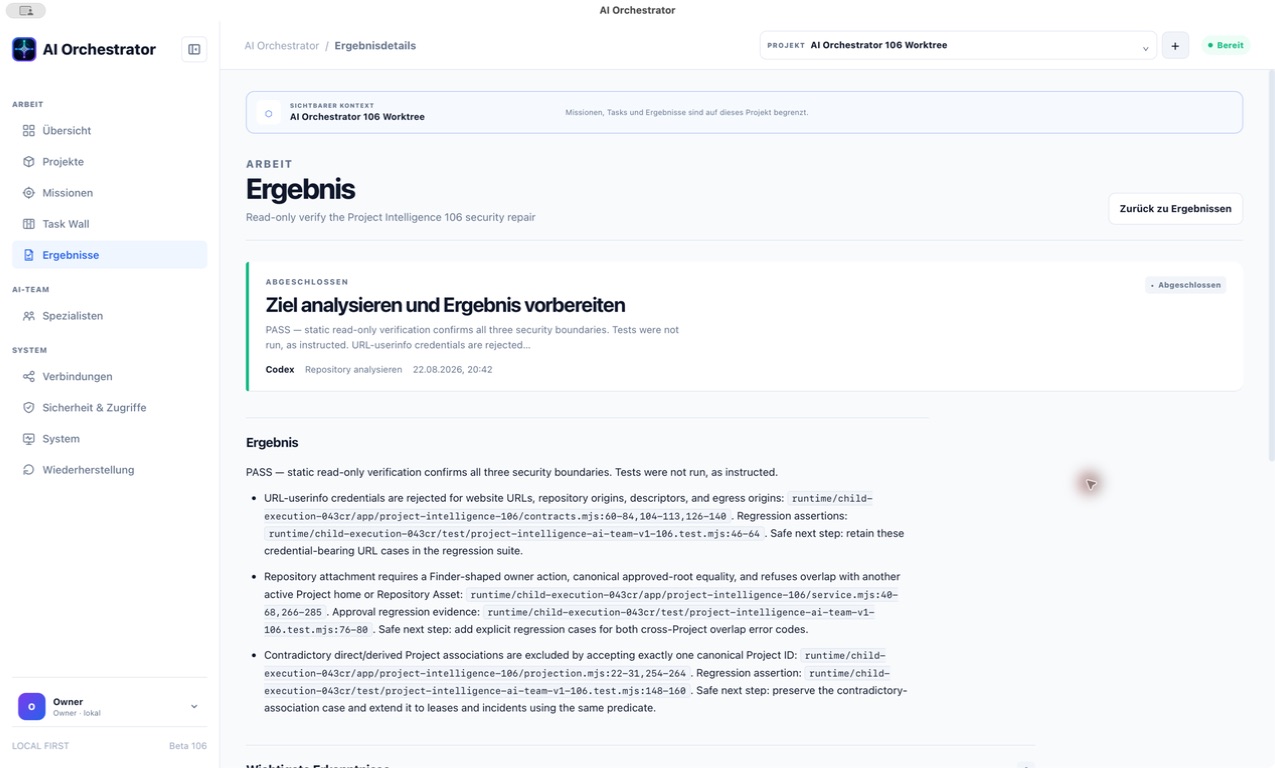
The chain
Five steps from work to result
None of these steps is optional. A mission only counts as delivered once the whole chain has run.
- Execution Receipts
Specialists work through the tasks in bounded sessions. Every session leaves structured evidence: what was read, changed, checked.
- Verification Checks
Claims are held against the evidence, and the request against the result: do they actually match?
- Independent review Review
A separate instance with its own completion authority checks against the goal. It is never the executor — and a reviewer from the same provider family is refused.
- Canonical result Result
Only the confirmed result becomes binding: one version that counts, with all the evidence behind it.
- Your acknowledgement Owner
You see the result, the evidence and the open points. Your acceptance closes the delivery — consciously, not automatically.
The language of evidence
Every statement has a kind
Results and findings in Undernap carry their provenance openly — in four kinds.
Every statement tells you what kind of evidence it rests on — so you can see at a glance what is observed, derived, inferred or still unknown:
Derived from observations and recomputable — you can walk the path.
A reasoned assumption. Never presented as fact.
Not determinable. Said, instead of guessed — and treated as what it is: unknown.
Evidence instead of memory
The difference between “trust me” and “look yourself” is record-keeping. That is why Undernap writes the execution down:
Structured receipts
Every execution leaves a compact, structured, addressable and durable record — not a remembered history.
“What supports this?”
The result literally carries that question: every statement points to the evidence that backs it.
Demotion, not promotion
A statement can be graded down after the fact — from observed to inferred. It can only improve through evidence, never through repetition.
Results know their boundaries
Every result belongs to a project. Missions, tasks and results are bounded to that context — a result from project A does not surface in project B, and a request only gets the context you give it.
The last step is yours
Nothing closes automatically. You see the result, the evidence and the open points — and your acceptance closes the delivery. That deliberateness is the point: a workspace that asks for decisions stays your workspace.
What this chain does not promise
So it stays clear what it stands for — and what it does not:
- It does not make a result true. It makes visible what the result rests on — and what is unevidenced.
- It does not replace your judgement. It gives you the basis to exercise it at all.
- It is not a guarantee of correctness. It is a guarantee that “done” was checked rather than claimed.
Trust is good. A chain is better.
See the chain for yourself: ask for a seat in the Founder Beta — or read how a mission runs.
Founding Beta for macOS (Apple Silicon, macOS 12+). Nothing is sold yet and there is no public download — access goes through the Founder Beta.