

Ten tabs, no state
Every tool keeps its own history. None of them knows where the others stand — and you are the integration layer in between.
For people and teams coordinating multi-step AI work.
You tell Undernap the outcome you want. Undernap turns it into a Mission: a plan you approve, tasks for specialists — executed over the AI accounts you already have — an independent review, and, at the end, a result with evidence.
Founding Beta for macOS (Apple Silicon, macOS 12+). Nothing is sold yet and there is no public download — access goes through the Founder Beta.
Anyone working with AI seriously ends up with several tools: a chat model here, a coding agent there, a second account for capacity. That works — until the job outgrows a single window.
Every tool keeps its own history. None of them knows where the others stand — and you are the integration layer in between.
Shuffling results by hand, explaining the context twice per tool. In the end nobody can say which version counts.
An answer sounds good. Whether it matches the job, nobody checked — and that lands back on you.
Hit the limit of one subscription and everything stalls, while a second account sits there with capacity to spare.
Undernap does not replace your AI tools — it puts them in order. Five things change, concretely.
You break the work down yourself, carry the context from window to window and keep the state in your head.
One request with a plan, tasks, ownership and a defined end. The state lives in the product, not in your memory.
Deciding afresh at every step which model is probably best at this part.
Roles with a quality bar — research, implementation, review. Which connection runs a role is settled by the plan.
Several subscriptions that know nothing about each other. One is at its limit, the other is idle.
Your connected AI accounts as one pool of work capacity: capacity becomes visible, roles get staffed, limits get respected.
You read the answer and hope it holds. Checking it means reading everything yourself.
A separate instance checks against the goal before you see the result — never the one that did the work.
Five windows, five partial truths, and you do the merge.
One version that counts — with the evidence behind it and your acceptance at the end.
You stay the deciding authority at three points — at the start, before anything runs, and at the end.
The goal in your words — plus limits: read-only, nothing deleted, budget.
You decideUndernap proposes the plan, the roles and the limits. Nothing runs before that.
You decideSpecialists work over your AI accounts — in bounded sessions that leave evidence.
Verification and an independent review decide whether “done” is actually done.
One result with its evidence. Open points wait visibly for you.
You decideA design preview of Undernap’s dark interface: layout, terms and flow follow the real screens of the running Founding Beta — whose interface is still light today.
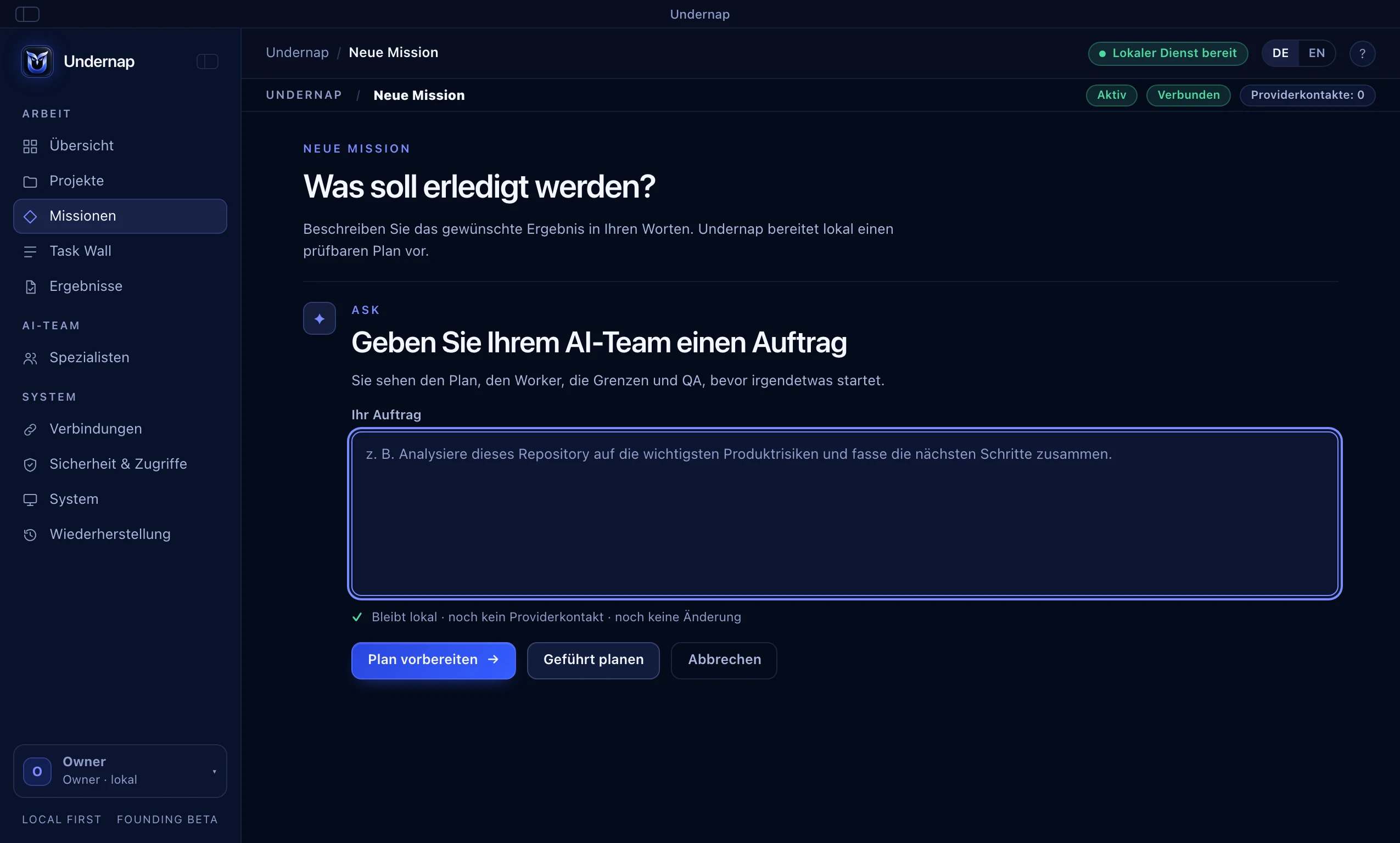
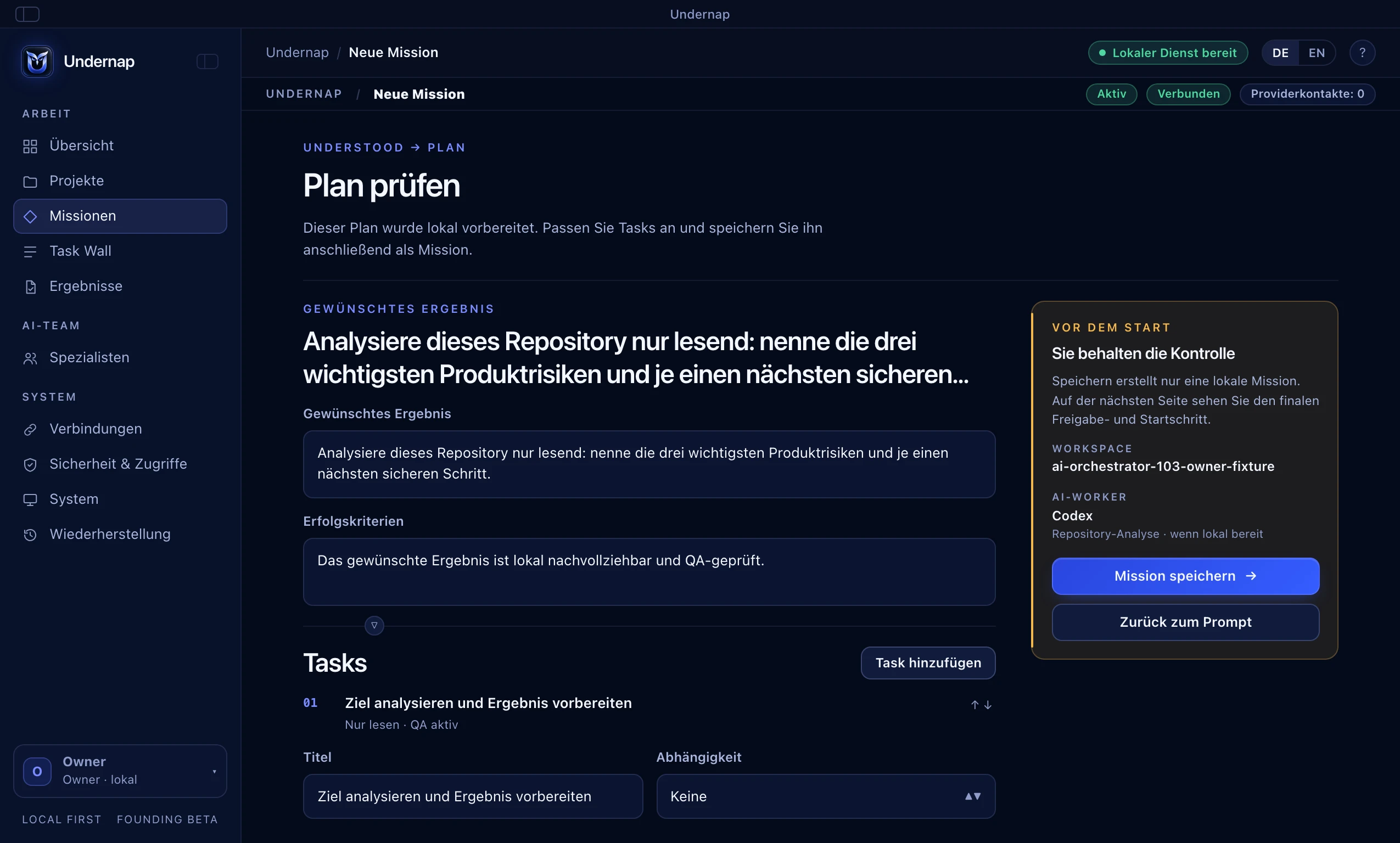
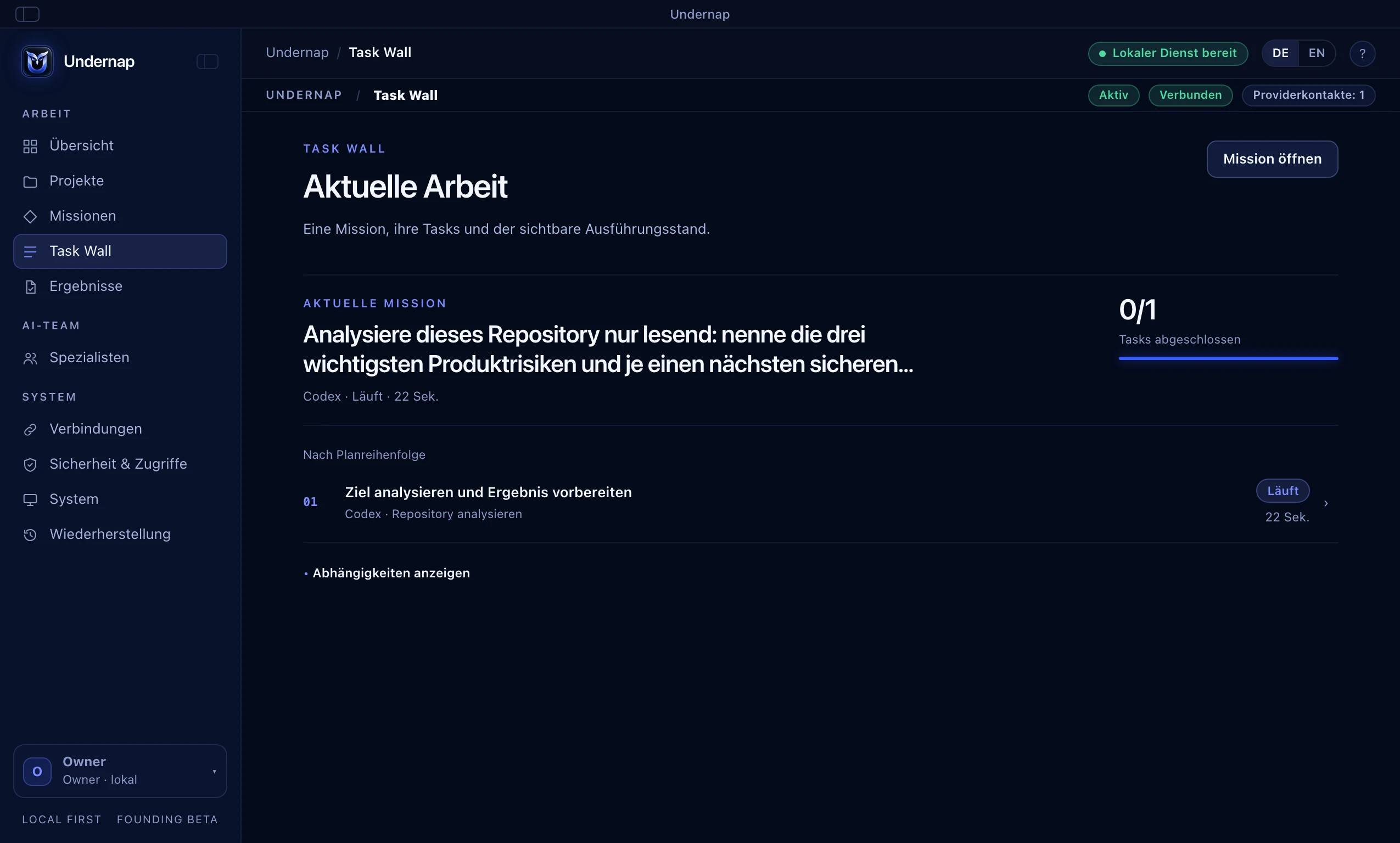
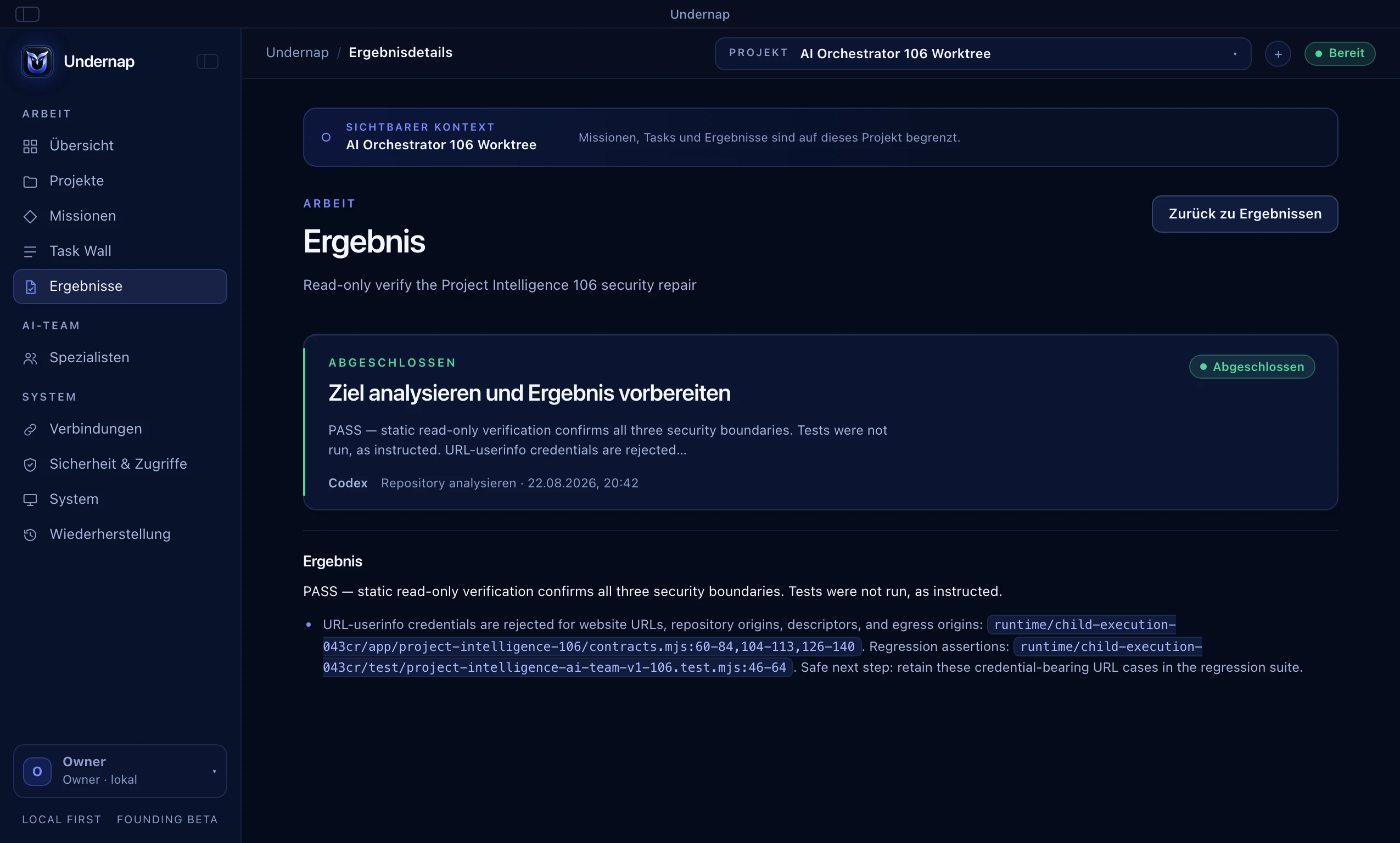
The previews are built on the real Founding Beta screens and show nothing the product cannot do today. Real, unretouched captures — carrying the development name the app still shows — are further down beside the Result chain and on the Result & evidence page.
The strongest part of Undernap is not that it distributes work — it is that you can trace what happened to it. Every Mission runs through the same chain:
Specialists work through the tasks in bounded sessions. Every session leaves structured evidence.
Results are held against the request: does what is claimed match what is evidenced?
A separate instance decides — never the one that did the work. A reviewer from the same provider family as the executor is refused.
Only when the review confirms against the goal does the Result become binding — with the evidence behind it.
You see the result, the evidence and the open points — and your acceptance closes the delivery.
Three of the roles that exist in Undernap today — and what comes out of them.
“Analyse this repository read-only and name the three biggest product risks.” Out comes a risk report with file-level evidence — checked by an instance that is not its author.
Technical, content and discoverability findings — each statement marked observed, derived or inferred. No metric without a provenance.
A briefing with what is evidenced — clearly separated from what was merely concluded. No invention presented as fact.
Undernap does not sell AI usage. You connect the accounts you already have; together they are your Fleet. The value of several accounts is not status, it is division of labour:
Proven in operation through the product: Claude, Codex, Grok, MiniMax, Z.ai GLM and OpenRouter (free pool). Further providers are qualified one by one before they count as usable.
Research, implementation and review are different jobs. Different accounts and models may suit them differently well — the role still stays the role.
Two accounts with the same provider are two parallel workstations. When one hits its limit, Undernap waits or moves within your rules — limits are respected, never circumvented.
For the independent review: an instance from the same provider family as the executor is refused. Real checking needs real distance — that is built in, not promised.
Just as valid. The Fleet grows when you grow — Undernap does not require a second subscription to be useful.
Automation without control is just a faster route to the wrong result. Four boundaries are therefore settled in the product, not in a promise.
The plan, the judgement calls along the way and the acceptance at the end are yours. Nothing closes itself.
Paid execution needs clear limits and your approval. There is no quiet consumption in the background.
No provider is added that you did not connect. Your Fleet is exactly what you set up.
Undernap runs on your Mac. Project knowledge, missions and results live in your local data directory — not in our cloud.
Undernap is a Founding Beta — it cannot be bought yet. What is already settled is the economics of the product:
The Founder Beta opens in small steps. Ask for a seat, confirm your email — and you will be among the first to hear when access becomes possible. No advertising, unsubscribe any time.
Founding Beta for macOS (Apple Silicon, macOS 12+). Nothing is sold yet and there is no public download — access goes through the Founder Beta.